Wednesday, July 31, 2013

This is your Brain on FoxNews

'Poached Scrambled eggs in the pot' photo (c) 2006, Seth Anderson - license: http://creativecommons.org/licenses/by/2.0/If you grew up in the 90’s, you likely remember the commercials warning of illegal drugs turning your brain to mush if you used them.  Well, turns out drugs aren’t the only things that can turn our brains to mush. Recently there was a story on NPR regarding the power of personally held stereotypes to shape our perception of life. In particularly, the research was emphasizing the problems racial stereotypes cause in real life. While obvious hate-filled racism is less mainstream thankfully—though certainly exists below the surface—it is this stereotypical racism that plays out in much subtler, yet equally dangerous ways.  And perhaps this racism is even more dangerous than the obvious hatred of the Klu Klux Klan or white supremacists groups. This racism is often oblivious even to the person who holds the racist biased.  One can therefore proudly proclaim to be free of bias and prejudice while almost unconsciously holding to prejudicial stereotypes.

One example of this is from the documentary film Freakanomics, where Morgan Spurlock describes sending out identical resumes to job seekers, the only difference being that one copy would have a name that sounded “white,” and the other “black.”  Spurlock found that the “white” sounding name received call-backs far more often.   I’m sure we can all think of less troublesome racial stereotypes, like white men can’t jump, or blacks have natural rhythm.  I’m sure many of us can also think of much more troubling stereotypes.

Stereotypes are helpful in some ways. I’m not an evolutionary biologist, but I imagine a scientist would say that the brain developed the ability to stereotype so as to know when to flee from potential danger.  Seconds probably meant the difference between life and death, so every second could be the difference between life and death.  It’s not necessarily that stereotypes are always bad, or always wrong.  Financial experts stereotype by warning us that letters from foreign nationals telling us we’ve won a lottery are always a scam.  My mother stereotyped in advising me “that if it sounds too good to be true, it probably is.”  Yet, stereotypes often have a dark, sinister side that we don’t always notice firsthand.  Stereotypes such as “welfare recipients are lazy,” “rich people are all selfish and greedy,” and as recent events remind us, “black males in hoodies are dangerous.” Yes, guilty verdict or not, Trayvon Martin would still be alive today if he had not been negatively racially stereotyped. 

The real problem with stereotypes is that they simple reinforce our previously held beliefs, to the point where they become self-fulfilling.  If I think black males in hoodies are troublemakers, I’m going to track down and harass a teenager armed with a bag of skittles—even when the police tell me not to—because  he’s “suspicious,” “up to no good, ” and an “asshole.” This is a key element of Systems Theory, a framework for understanding human behavior, which points out that human beings tend to notice things that reinforce one’s current beliefs. We all like to think we’re keen observers, but in reality we only see what we already think exists. 

Author Jesse Rice shares a story of a social experiment done by the BBC TV series Horizon. Six people agreed to subject themselves to 48 hours of sensory deprivation , placed in pitch black rooms, clothed in thick clothes and gloves, and adorned with frosted goggles and white-noise playing earphones.  Having their mental functions tested prior to beginning the experiment, the isolation soon gave way to serious cognitive impairment with participants imagining sights, sounds, and senses that were not real. The observation was made that cut off from connection, humans’ ability to make sense of the world and deal with reality quickly breaks down.

'Fox News GOP Merger - Faux News' photo (c) 2007, New England Secession - license: http://creativecommons.org/licenses/by/2.0/So what’s the point? Our brain needs to be constantly presented with new ideas and information in order to not fall into locked-in stereotypes.  “Just as neural pathways form in our brain as a result of stimulation, there is now research to show that the opposite may also be true. If the brain does not get the stimulation it needs, it begins to turn to mush.”  Is it then any surprise that the avid Fox News watcher thinks that President Obama is some socialist intent on handing out their money to entitlement moochers via government programs? No, their brain has essentially turned to “mush.”  Having subjected itself to the same stimuli (AKA GOP Propaganda)over and over again, with the tendency to only see self-fulfilling examples, their brain essentially loses the ability to reason, relying only on preconceived stereotypes, oblivious to logic.

It is ESSENTIAL then to constantly be seeking out and encountering new mental stimuli.  To purposefully expose oneself to ideas and influences that fly in that face of one’s currently held beliefs. One of the researchers from the NPR story told of the powerful effect an image had on herself, challenging her own preconceived ideas, that of a female construction worker breast-feeding her child on her lunch break.  Constantly challenging our brain is like lifting weights for our muscles. If we don’t want our brains to turn into a stereotypical mush, unable to think beyond our own ideas or opinions—we’ve got to be always open to new ideas and opinions. 

Monday, July 22, 2013

What would you take if you had 5 minutes to grab & go?

'fire 5' photo (c) 2006, Loco Steve - license: http://creativecommons.org/licenses/by/2.0/

Due to the lack of moisture and hot summer temperatures, Colorado once again is in the midst of a tough forest fire season. The Black Forest Fire this past June was particularly damaging, causing an estimated $85 Billion in damages, nearing the $110 Billion in damages from the Waldo Canyon fire of 2012.  Both fires were particularly costly because they burned in residential areas, consuming scores of structures and property.  While I have written in the past about forest fires and public policy, I wish to explore another perspective.

Shortly after the Black Forest Fire, Colorado Public Radio interviewed a resident who had recently been allowed to return to his property.  He was fortunate in that his home had been spared, despite the destruction of other homes nearby.  Recounting how he had only a few minute’s notice to evacuate, the interviewer then asked the man what he had taken.  He shared that he had taken some family keepsakes and photo albums.  The interviewer then asked another intriguing question, that being what item or items the man had not taken that he would have on second thought.  While he mentioned an antique restoration project in his garage, I myself pondered what items I would choose if in a similar predicament.

Having given it some thought, there are certainly a few things I would grab such as photo albums, my wife’s scrapbooks, and my journal. I’m not sure there are many other “must haves.” Though CPR doesn’t have the lists yet accessible of what others would grab, I imagine their lists would be similar to mine; Family keepsakes, pictures, treasured notes, etc.  It’s funny in a way to think about all the things we would not be first to grab, the things that are worth the most monetarily. Things like flat screen TV’s, computers, appliances, and so on. Sure, someone might grab their laptop or tablet, but that surround sound stereo is most likely staying put.

I’m reminded of the rom-com Leap Year, in which Amy Adams’s character is challenged by a rival love interest to measure the strength and depth of her current relationship based on what he would grab in the event of a fire. Sure enough, back home and recently engaged, she pulls the fire alarm and watches in stunned silence as her fiancé rushes around grabbing technology.  Realizing the relationship has no depth or value she leaves him and goes off to the other guy.
'Gold-Treasure' photo (c) 2008, Mark Herpel - license: http://creativecommons.org/licenses/by/2.0/
 

What also comes to mind is the admonition in Matthew 6:19-20. Here, Jesus is recorded advising his followers to not invest in things that can be stolen or destroyed, but rather that which is everlasting.  Isn’t that just the opposite of what we do though? We buy into the consumerist mindset of having the latest tech  gear, the trendiest fashions,  and the most elegant furnishings. We work long hours, sacrificing time with friends or family so we can make money to buy all those “treasures;” otherwise known as all the things we will leave behind in a fire and will subsequently get burned up or otherwise destroyed. 

The past few years at Christmas I’ve tried to back away from asking for gifts—stuff that’s just going to go bad or get destroyed. In fact, I’ve began asking for things that won’t just end up in a landfill one day.  I’d rather have gifts like a memorable dinner, an unexpected surprise, or a special act. These are things which won’t go bad and things which I can always take with me.  And of course, relationships are what these gifts are all about.

So let’s spend less time and money investing in things that will go bad, get destroyed, or end up in a landfill. Rather let’s spend what time and resources we have on each other, on our relationships—building on the one’s we currently have and engaging in making new ones.—for it’s our relationships and our memories that will always be with us.

Tuesday, July 9, 2013

Why student loan forgiveness must happen!

'cooperunion_dec08_DSC_0195' photo (c) 2012, Michael Fleshman - license: http://creativecommons.org/licenses/by-sa/2.0/
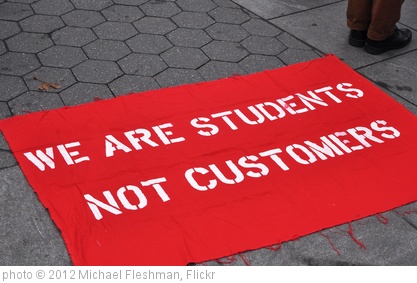
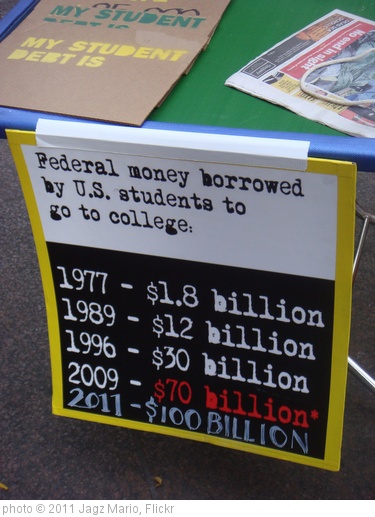
Outstanding student loan debt in America is roughly $1 Trillion, surpassing auto loans and credit cards as the biggest source of consumer debt besides mortgage loans.  Each year 60% of college student borrow money to help pay for college.  Adding in past borrowers, the number reaches approximately 37 million nationwide. Of those 37 million, the under 30 age demographic has the most borrowers at 14 million. The average student loan balance for all age groups is $24,301 with an average monthly payment on student loan debt is about $290. That’s a lot of money!

The average income for college graduates is $37,000 to $62,000, depending on degree field. If a graduate with student loans is making $50k a year, about $10,000 of that will go to taxes (be they federal, state, FICA, etc.)  Of that remaining $40,000, about $300 monthly will go to student loan repayment. That’s nearly 10% of one’s monthly income! How’d you feel about losing out on 10% of your income EVERY month for at least ten years.  That’s about $35,000 over the life of the loan repayment. It’s quite a hefty sum.

As student loan debt creeps its way into the political conversation more, those who have never had to take out student loans are often the most outspoken.  Either their parents were well off enough to pay for their schooling out of pocket, or they followed the advice of Mr. Mitt Romney and “borrowed money from (their) parents.”  In some cases there seems to be a sense of superiority, that they are better because they didn’t have to borrow money for school for whatever reason(s). 

Anyone who was able to work their way through college or get a scholarship should be grateful, not vengeful to the others who did not. In reality, only about 10% of college students get scholarships, and most jobs aren’t going to cover every expense either. Further, if  parents footed the bill, that says nothing of one’s own abilities, only theirs.  As author Randall Robinson wrote, true to American capitalism, you simply got to start from where your parents left off.

'Stats about student debt' photo (c) 2011, Jagz Mario - license: http://creativecommons.org/licenses/by-sa/2.0/So with student loan debt being roughly $1 Trillion, this is an issue that isn’t going away. It’s inevitable that student loan debt will soon become the punching bag of conservatives.   The mythical ideology of “personal responsibility” stands in stark contrast to student loan debt. Student loans are all about depending on the government and not being “self-sufficient,” both of which the Right detest.  They will cry, “why bail out irresponsible students who didn’t take enough responsibility to pay for their own education?” Or, the familiar, “why should ‘makers’ subsidize the ‘takers’?” Trust me, it’s going to happen. And unless something drastic happens, the cycle will only continue, for instead of saving money for their kids’ college education, debtors will still be trying to pay off their own.

Here’s the reality. America has been cutting higher-ed funding and raising tuition for years just to keep taxes on the rich low. While the Right blames government for rising tuition rates, they ignore the cuts they themselves impose to state education budgets.  Public policy has created the student debt situation we have today. Don’t tell me now that debt forgiveness is letting borrowers off easy.  If America had been doing the right thing, we wouldn’t have this situation to begin with.  For the future of American commerce we need an educated workforce, for the future of our democracy we need an educated electorate, and for the future of our society we need an educated populace.  Look, we could have avoided this problem in the past by doing the right thing, but the problem can still be fixed. It’s as simple as student loan forgiveness. Let’s do this!

Sunday, June 30, 2013

Republicans, doing their best to destroy America’s freedom


Last week will go down in history as a significant date in American history thanks to the Supreme Court of the United States and their 5-4 decision declaring the Federal Defense of Marriage Act as unconstitutional.  Predictably, Republican leaders bemoaned the defeat, declaring the demise of America. Personally, it’s beyond me how giving the same rights and benefits to all people is itself un-American, but remember, these are Republicans we’re talking about. In their upside down world, equal rights is a bad thing while dismantling the guarantee of equal protection for others is a good thing. What I’m speaking of specifically is the dismantling of the Voting Rights Act by the Supreme Court. 

While the death of the Defense of Marriage Act (DOMA) is certainly worth celebrating for some time, I fear that most Americans will soon forget (and likely have already have forgotten) about the tragic dismissal of the Voting Rights Act of 1965 by this same Supreme Court.  The Voting Rights act was enacted by Congress to limit the power of states to disenfranchise individual voters.  Southern, white- dominated states had since the end of the Civil War Reconstruction done nearly anything and everything to keep African Americans from fulfilling their constitutional right to vote. Racist whites in the south put barriers into place such as poll taxes, literacy tests, and limited voter registration access all to keep African Americans from voting successfully. The Voting Rights Act mandated that any law passed by certain states had to have approval from the federal government before the laws could actually be put into place. Now however because of the decision of the Supreme Court last Tuesday, states formerly required to seek approval from the federal government can now do whatever they want.

'Vote!' photo (c) 2008, kristin_a (Meringue Bake Shop) - license: http://creativecommons.org/licenses/by-sa/2.0/
Texas, one of the states formerly covered under the law wasted no time, immediately enacting a Voter ID law and re-drawn district maps that were previously disallowed.   The Voter ID requirement is purported by voting rights activists to be another effort to disenfranchise minority voters while the re-drawn district maps similarly were understood by the Voting Rights law to purposefully limit the voting power of minorities.  Juxtaposed to the decision of the Court on gay marriage, this dismissal of the Voting Rights act seems make it seem like one step forward, two steps back for America.

The Supreme Court is made up of nine justices, five of which were appointed by Republican Presidents, four by Democratic Presidents. Oddly enough, it was the five Republican appointees which made up the 5-4 majority which gutted the power of the Voting Rights Act.  I say oddly because the Republican Party has been preaching a gospel of “freedom” and “liberty” in response to the “tyrannical rule” of President Obama and his supposed “socialist agenda” for the US.   One would think that Republicans of all people, would be for enhancing, not detracting from, one’s ability to vote.  After all, the US Government is a government “of the people, by the people, and for the people” as Lincoln so famously said in his Gettysburg address. The individual voter is essential in our democracy and liberty. Ironically enough, even with the defeat of California’s Prop 8, the loss of the voting rights law will make it easier for unjust and unconstitutional laws like Prop 8 to be put into place.

'I Voted!' photo (c) 2008, Julie Vazquez - license: http://creativecommons.org/licenses/by/2.0/Beyond the conservatives in the Supreme Court, Republicans nationwide are passing bogus voter-ID laws, limiting voting hours, purging voter rolls and enacting 25 state laws making it tougher to exercise one’s constitutional right to vote. Voter fraud is a complete myth, a “problem” created by conservatives as an excuse to enact laws to limit minority voting (who tend to vote Democratic).  It’s entirely hypocritical that a political party so “devoted” to freedom and liberty would purposefully limit the rights and freedoms of others. If Republicans were really about freedom and liberty, they would be celebrating the recent laws in Colorado that make it easier for people to take part in the democratic process and vote.

 If I didn’t know better, I’d think most Republican leaders just weren’t that intelligent, that they can’t recognize the obvious hypocrisy and inconsistency amongst their “freedom and liberty”.  But, I actually do know better. Truth is, when conservatives talk of freedom and liberty, they mean freedom and liberty for themselves only.  Therefore, conservatives can talk of “freedom and liberty” while at the same time limiting the voting and marrying privileges of others, because in their efforts to “restore America” to the time of the Constitution and the Founding Fathers, Republicans would seemingly like to see America also go back to the days when the only people who were able to vote were rich, white, males. The only freedom and liberty conservative Republicans really want is the freedom from diversity, equality, and true liberty for all.    

Thursday, June 20, 2013

Please don’t call me lazy…

'Lazy Dog' photo (c) 2010, Stephen Nakatani - license: http://creativecommons.org/licenses/by/2.0/
Lazy Dog

The other day at work when I was hot, tired and in need of a break I gladly passed off a task to a lower level employee who in turn muttered that my actions (or perhaps lack thereof!) was because of “laziness” on my part.  I recount this not because the estimation of this co-worker matters to me—I care more about Kim Kardashian’s choice of wardrobe than this person’s opinion—but because it seems to speak to a larger culture I’ve seen a play for some time.  It speaks of an attitude where those in power and authority get to throw out labels like “lazy,” “apathetic,” or “stupid.” It’s frustrated me for some time, having words like that carelessly thrown about in the direction of myself or others.

Recently I was reading from the book Fully Awake and Truly Alive, a book on spiritual practices by Reverend Jane Vennard.  In a section on humility—certainly something we all could use a little more of (myself included)—Vennard mentioned that spiritual growth is accepting our own limitations and the limitations of those around us.  She writes that “when we encounter limitations in others, we are tempted to judge and to blame.” It’s just so easy to do, to hold someone to our own set of standards or guidelines. Now I’d be untruthful if I claimed innocence, but as someone who has also been on the receiving end of judgment (and often powerless to do anything about it), I can attest to how unhealthy  and unconstructive such labels are.

Implied within Vennard’s thoughts is that we are mistaken when we assume our norms are universal for everyone. Perhaps I was being “lazy” in the mind of my co-worker, yet I doubt he was aware of how hard I had been working, how I was tired at the end of a long week, how I go home and run a few miles after work, how I come home to take care of my young child and try to keep the house from looking like a nuclear waste dump… He may think I’m lazy, but I bet he didn’t have to change diapers and do laundry the night before. That’s the problem with assuming our standards should be the norm for everyone else.

To counter this temptation, Vennard recommends that we take the wider view and let go of judgment and blame.  She understands this to be an important part of humility—being unwilling to look down on anyone else.  If I’m truly humble, can I really assume I’m better than everyone else? Further, she asserts  that beyond letting go of the judgment and blame we should instead trust one another. “Can we trust that others are doing the best they can at the moment?” she asks. That means letting go of the judgment and mistrust and rather giving one another the benefit of the doubt—simply giving others the benefit of the doubt we would want others to give us. After all, most of the time I would say I am doing the best I can at the moment based on the circumstances.  Can we assume the same for others? So can we be as gracious with others as we are with ourselves? Can we recognize there are circumstances beyond our knowledge at work in their own lives, just as there is in ours?  

Rather than throwing out hurtful and judgmental labels, let us be gracious and generous with one another. Let’s be humble and caring, understanding our own ways might be best for ourselves—but not everyone else. Let’s trust that others are doing the best they can at the moment. After all, that’s really all anyone can ask for isn’t it?

Sunday, June 9, 2013

Beware Obama’s coming Liberal Zombie Army

Freedom loving Americans beware, President Obama is crafting a plan to turn “kids into debt zombies working for Big Government and various liberal causes.” You read that correctly, op-ed writer Aurther Herman is concerned that Obama is taking advantage of the growing student debt load to create an army of mindless Obama-drones.  Herman cites a plan by the Obama administration that would limit debt payment for student loan borrowers to 10% of their income after taxes and expenses.  After ten years of making these payments, the student debt would be forgiven for grads working in certain public or private fields. Specifically, that looks like graduates who teach in a public school or work for a 501c(3) charity—not any of the  501c(4)s that have been “targeted” in the IRS scandal as Herman tries to suggest. Also conveniently left out by Herman is the fact that military vets also qualify—further “shooting holes” in Herman’s theory. 

'barak-obama' photo (c) 2008, José Luís Agapito - license: http://creativecommons.org/licenses/by-nd/2.0/
It’s hard to know what Herman is referring to exactly, since like so many other conservative conspiracy theorists, Herman fails to cite any actual data or writing, but he may be referring to a recent suggestion by Obama to extend a law created in 2007 under the Bush Administration that allows borrowers to limit student loan repayments to 15% of their income for 25 years.  Currently, only borrowers with loans taken out after 2007 can utilize this plan. Obama is proposing enabling borrowers with loans taken prior to 2007 to utilize this plan as well.

Herman asserts that the solution is to get the federal government out of the student loan business. Why? Because the US Government made $51 Billion profit last year? No, it’s because back in 2009, Obama engineered a law change that took private companies out of the federal student loan business.  Prior to this law going into effect, private banks were making $15 billion a year by simply handing out the government’s money. The change was projected to save the US Government $87 billion over 10 years. Seems like a no-brainer right? Wrong. See, what Herman and his other conservative cronies want is to be able to make money off the tax-payer and student loan borrower. Herman cries that the government will lose out on $300 million by 2020 due to the forgiveness program, yet mentions nothing of the $87 billion saved, and rather proposes the program be done away with. Like other fiscal conservatives, Herman likes to talk the talk of “reining in government spending” and “saving taxpayer dollars,” but in reality is all about making the Benjamin’s for himself.

The constant bashing of higher education by conservatives is frankly a bit confusing, since most of the time the common refrain is that the private industry can do things better and cheaper than government can. Yet, strangely enough, private education is vastly more expensive than public college.  So, it leaves me to wonder what conservatives have against college education in general.  Yes, there is the tired charge that college is a breeding ground for liberal indoctrination, but then again, these are the same folks who reject the teaching of critical thinking skills in public schools. Maybe it’s that the fact that since the majority of post-recession jobs pay less than $14 an hour, a less educated workforce will be cheaper to pay.

'Occupy Cincinnati' photo (c) 2011, Rusty Ray - license: http://creativecommons.org/licenses/by-nd/2.0/One thing for sure, I find it all too hypocritical that the folks decrying the federal student loan program never actually had to take out student loans themselves to pay for their education. Sorry Mitt Romney, but not all of us have parents rich enough to borrow money from. Sorry, not all of us had parents who earned enough to pay for our education.  Sorry, not all of us got handed great-paying jobs while in college to finance that education. Why is it that the US Congress, which has a median net worth of over $1 million, gets to decide how much my student loan interest rates should be? Especially when the federal government is handing out interest free loans to many of the same banks that crashed our economy. Oh, maybe it’s because banks are getting an $83 billion a year federal subsidy that in turn boosts profits and lines the pockets of investors, which my friend Author Herman most likely benefits from.

Is college expensive? Absolutely. Has the cost of college rise dramatically? You bet. But how is reducing taxpayer funding to higher ed going to help that? How is reducing student loans and Pell grant availability going to bring the costs of college down? The common conservative prescription of eliminating government programs simply pretends problems go away when the program is eliminated.  College is an extremely important part of growing up, and while it may not be essential for all—it is important for many. Whether it be learning new ideas, meeting new people, growing up to become your own person, or meeting that future significant other college is an essential rite of passage in our culture. So to critics like Herman who can do nothing but complain rather than offering decent solutions to make college more affordable, I suggest the old adage, if you don’t have anything good to say, don’t say anything at all.

Wednesday, June 5, 2013

Give more than just money, give a vision!


'Disneyland' photo (c) 2011, Sean MacEntee - license: http://creativecommons.org/licenses/by/2.0/
Have you ever heard story of Walt Disney and the opening of Disneyland?  The story goes that someone lamented that Walt Disney was not alive to see the opening of Disneyland, to which someone else replied, “he did see it, that’s why it’s here.” This story highlights the importance of visioning—being able to see a new way, to imagine things currently not in existence or unattainable.  Vision—and I don’t mean simply 20/20 eyesight—is essential to growing, achieving, and advancing in life. I’m reminded of a Bible verse I heard so often during my time in Bible college.


“Where there is no vision, the people perish” – Proverbs 29:18a KJV

These eight words form just the first half of verse 18 in Proverbs 29, which translated from The Message reads a little clearer. “If people can’t see what God is doing, they stumble all over themselves; But when they attend to what he reveals, they are most blessed.” The verse sits amongst a chapter full of pithy statements and wisdom sayings.  Despite being modernized by Eugene Peterson, the words just seem to have more truth to them when stated in the old King James Version language. “Where there is no vision, the people perish.”

I’m reminded of a Christian film titled The Second Chance, which tells of an inner city church that exists as a mission church of a large, well-to do suburban church.  The story begins at the suburban church on what is “The Second Chance Sunday,” (also the name of the inner city church). The Second Chance pastor is less than thrilled about being there as he doesn’t want to be just brought in for show in order to appease the conscience of the congregation, so they can feel good about where they send their checks off to.  Speaking in front of the church, when he is supposed to be lauding them for their generosity, he rather exhorts that they come down to The Second Chance and support the ministry there.  He proudly proclaims that if they are unwilling to do so they should rather “keep your damn money.”

What the pastor in this movie was getting at is that people don’t just need funds, they need friends. In his book With Justice for All, author John M. Perkins repeatedly asserts that poor people don’t need just the charity of the rich, they need the relationships.  Perkins emphasizes that successful people should go beyond simply writing a check, rather they should take time out of their schedule to mentor an at-risk teen, help a young adult receive job training, or teach a person a valuable business skill. Most importantly of all, Perkins stresses that people need to be shown that a new way is possible; they need to be given a vision.

'Optometry letters from eye chart' photo (c) 2013, Les Black - license: http://creativecommons.org/licenses/by-sa/2.0/
Perkins recounts a time talking to a teenage girl, who was determined to take care of her future children and be a good single mother. Perkins was perplexed that she was content settling for so little, yet then he realized that the teen did not know of another way. She lived in a subsidized apartment building, with rental assistance being structured in a way that discouraged two parent families.   All she saw then was single moms living off subsidies.  She was driven enough to realize she wanted to be the best single mom she could be—but it stopped there. She couldn’t imagine life beyond that apartment building, beyond being a single mom. She needed a new vision.

I’m also reminded of a story I heard on NPR a while back, about a woman who was on disability in a small town in Alabama. The woman suffered from chronic back pain, making any job that required a significant amount of standing simply unbearable.  When the reporter asked this woman what kind of job she would like to have, the woman mentioned a job at the Social Security office.  After some clarification, the reporter realized that the woman did not really want to work for Social Security, rather this was the only job in town she knew of which didn’t require standing. Think about that. She couldn’t imagine a job that would enable her to sit and work—other than this desk job working for the SSA.  She couldn’t see another way.

Charity is easy, clean, and hands off. It enables one to soothe their conscience without ever making a real dent in the problem.  Is charity important? Absolutely, but people need more than just your charity, they need your vision. They need you to come down to the community center and teach them the skills they need to get a better job, they need you to come to their school and help them with their math, they need you to come to where they play and spend time with them, but most importantly they need you to give them a vision for the future. A vision that is different than what they know, a vision that is bigger than what they could previously imagine, a vision, which they can claim for their own and see for themselves. Help them to imagine a new way for themselves.

If you really want to make a difference in someone’s life, don’t just write a check, give of yourself and give them a vision.