Sunday, June 30, 2013

Republicans, doing their best to destroy America’s freedom


Last week will go down in history as a significant date in American history thanks to the Supreme Court of the United States and their 5-4 decision declaring the Federal Defense of Marriage Act as unconstitutional.  Predictably, Republican leaders bemoaned the defeat, declaring the demise of America. Personally, it’s beyond me how giving the same rights and benefits to all people is itself un-American, but remember, these are Republicans we’re talking about. In their upside down world, equal rights is a bad thing while dismantling the guarantee of equal protection for others is a good thing. What I’m speaking of specifically is the dismantling of the Voting Rights Act by the Supreme Court. 

While the death of the Defense of Marriage Act (DOMA) is certainly worth celebrating for some time, I fear that most Americans will soon forget (and likely have already have forgotten) about the tragic dismissal of the Voting Rights Act of 1965 by this same Supreme Court.  The Voting Rights act was enacted by Congress to limit the power of states to disenfranchise individual voters.  Southern, white- dominated states had since the end of the Civil War Reconstruction done nearly anything and everything to keep African Americans from fulfilling their constitutional right to vote. Racist whites in the south put barriers into place such as poll taxes, literacy tests, and limited voter registration access all to keep African Americans from voting successfully. The Voting Rights Act mandated that any law passed by certain states had to have approval from the federal government before the laws could actually be put into place. Now however because of the decision of the Supreme Court last Tuesday, states formerly required to seek approval from the federal government can now do whatever they want.

'Vote!' photo (c) 2008, kristin_a (Meringue Bake Shop) - license: http://creativecommons.org/licenses/by-sa/2.0/
Texas, one of the states formerly covered under the law wasted no time, immediately enacting a Voter ID law and re-drawn district maps that were previously disallowed.   The Voter ID requirement is purported by voting rights activists to be another effort to disenfranchise minority voters while the re-drawn district maps similarly were understood by the Voting Rights law to purposefully limit the voting power of minorities.  Juxtaposed to the decision of the Court on gay marriage, this dismissal of the Voting Rights act seems make it seem like one step forward, two steps back for America.

The Supreme Court is made up of nine justices, five of which were appointed by Republican Presidents, four by Democratic Presidents. Oddly enough, it was the five Republican appointees which made up the 5-4 majority which gutted the power of the Voting Rights Act.  I say oddly because the Republican Party has been preaching a gospel of “freedom” and “liberty” in response to the “tyrannical rule” of President Obama and his supposed “socialist agenda” for the US.   One would think that Republicans of all people, would be for enhancing, not detracting from, one’s ability to vote.  After all, the US Government is a government “of the people, by the people, and for the people” as Lincoln so famously said in his Gettysburg address. The individual voter is essential in our democracy and liberty. Ironically enough, even with the defeat of California’s Prop 8, the loss of the voting rights law will make it easier for unjust and unconstitutional laws like Prop 8 to be put into place.

'I Voted!' photo (c) 2008, Julie Vazquez - license: http://creativecommons.org/licenses/by/2.0/Beyond the conservatives in the Supreme Court, Republicans nationwide are passing bogus voter-ID laws, limiting voting hours, purging voter rolls and enacting 25 state laws making it tougher to exercise one’s constitutional right to vote. Voter fraud is a complete myth, a “problem” created by conservatives as an excuse to enact laws to limit minority voting (who tend to vote Democratic).  It’s entirely hypocritical that a political party so “devoted” to freedom and liberty would purposefully limit the rights and freedoms of others. If Republicans were really about freedom and liberty, they would be celebrating the recent laws in Colorado that make it easier for people to take part in the democratic process and vote.

 If I didn’t know better, I’d think most Republican leaders just weren’t that intelligent, that they can’t recognize the obvious hypocrisy and inconsistency amongst their “freedom and liberty”.  But, I actually do know better. Truth is, when conservatives talk of freedom and liberty, they mean freedom and liberty for themselves only.  Therefore, conservatives can talk of “freedom and liberty” while at the same time limiting the voting and marrying privileges of others, because in their efforts to “restore America” to the time of the Constitution and the Founding Fathers, Republicans would seemingly like to see America also go back to the days when the only people who were able to vote were rich, white, males. The only freedom and liberty conservative Republicans really want is the freedom from diversity, equality, and true liberty for all.    

Thursday, June 20, 2013

Please don’t call me lazy…

'Lazy Dog' photo (c) 2010, Stephen Nakatani - license: http://creativecommons.org/licenses/by/2.0/
Lazy Dog

The other day at work when I was hot, tired and in need of a break I gladly passed off a task to a lower level employee who in turn muttered that my actions (or perhaps lack thereof!) was because of “laziness” on my part.  I recount this not because the estimation of this co-worker matters to me—I care more about Kim Kardashian’s choice of wardrobe than this person’s opinion—but because it seems to speak to a larger culture I’ve seen a play for some time.  It speaks of an attitude where those in power and authority get to throw out labels like “lazy,” “apathetic,” or “stupid.” It’s frustrated me for some time, having words like that carelessly thrown about in the direction of myself or others.

Recently I was reading from the book Fully Awake and Truly Alive, a book on spiritual practices by Reverend Jane Vennard.  In a section on humility—certainly something we all could use a little more of (myself included)—Vennard mentioned that spiritual growth is accepting our own limitations and the limitations of those around us.  She writes that “when we encounter limitations in others, we are tempted to judge and to blame.” It’s just so easy to do, to hold someone to our own set of standards or guidelines. Now I’d be untruthful if I claimed innocence, but as someone who has also been on the receiving end of judgment (and often powerless to do anything about it), I can attest to how unhealthy  and unconstructive such labels are.

Implied within Vennard’s thoughts is that we are mistaken when we assume our norms are universal for everyone. Perhaps I was being “lazy” in the mind of my co-worker, yet I doubt he was aware of how hard I had been working, how I was tired at the end of a long week, how I go home and run a few miles after work, how I come home to take care of my young child and try to keep the house from looking like a nuclear waste dump… He may think I’m lazy, but I bet he didn’t have to change diapers and do laundry the night before. That’s the problem with assuming our standards should be the norm for everyone else.

To counter this temptation, Vennard recommends that we take the wider view and let go of judgment and blame.  She understands this to be an important part of humility—being unwilling to look down on anyone else.  If I’m truly humble, can I really assume I’m better than everyone else? Further, she asserts  that beyond letting go of the judgment and blame we should instead trust one another. “Can we trust that others are doing the best they can at the moment?” she asks. That means letting go of the judgment and mistrust and rather giving one another the benefit of the doubt—simply giving others the benefit of the doubt we would want others to give us. After all, most of the time I would say I am doing the best I can at the moment based on the circumstances.  Can we assume the same for others? So can we be as gracious with others as we are with ourselves? Can we recognize there are circumstances beyond our knowledge at work in their own lives, just as there is in ours?  

Rather than throwing out hurtful and judgmental labels, let us be gracious and generous with one another. Let’s be humble and caring, understanding our own ways might be best for ourselves—but not everyone else. Let’s trust that others are doing the best they can at the moment. After all, that’s really all anyone can ask for isn’t it?

Sunday, June 9, 2013

Beware Obama’s coming Liberal Zombie Army

Freedom loving Americans beware, President Obama is crafting a plan to turn “kids into debt zombies working for Big Government and various liberal causes.” You read that correctly, op-ed writer Aurther Herman is concerned that Obama is taking advantage of the growing student debt load to create an army of mindless Obama-drones.  Herman cites a plan by the Obama administration that would limit debt payment for student loan borrowers to 10% of their income after taxes and expenses.  After ten years of making these payments, the student debt would be forgiven for grads working in certain public or private fields. Specifically, that looks like graduates who teach in a public school or work for a 501c(3) charity—not any of the  501c(4)s that have been “targeted” in the IRS scandal as Herman tries to suggest. Also conveniently left out by Herman is the fact that military vets also qualify—further “shooting holes” in Herman’s theory. 

'barak-obama' photo (c) 2008, José Luís Agapito - license: http://creativecommons.org/licenses/by-nd/2.0/
It’s hard to know what Herman is referring to exactly, since like so many other conservative conspiracy theorists, Herman fails to cite any actual data or writing, but he may be referring to a recent suggestion by Obama to extend a law created in 2007 under the Bush Administration that allows borrowers to limit student loan repayments to 15% of their income for 25 years.  Currently, only borrowers with loans taken out after 2007 can utilize this plan. Obama is proposing enabling borrowers with loans taken prior to 2007 to utilize this plan as well.

Herman asserts that the solution is to get the federal government out of the student loan business. Why? Because the US Government made $51 Billion profit last year? No, it’s because back in 2009, Obama engineered a law change that took private companies out of the federal student loan business.  Prior to this law going into effect, private banks were making $15 billion a year by simply handing out the government’s money. The change was projected to save the US Government $87 billion over 10 years. Seems like a no-brainer right? Wrong. See, what Herman and his other conservative cronies want is to be able to make money off the tax-payer and student loan borrower. Herman cries that the government will lose out on $300 million by 2020 due to the forgiveness program, yet mentions nothing of the $87 billion saved, and rather proposes the program be done away with. Like other fiscal conservatives, Herman likes to talk the talk of “reining in government spending” and “saving taxpayer dollars,” but in reality is all about making the Benjamin’s for himself.

The constant bashing of higher education by conservatives is frankly a bit confusing, since most of the time the common refrain is that the private industry can do things better and cheaper than government can. Yet, strangely enough, private education is vastly more expensive than public college.  So, it leaves me to wonder what conservatives have against college education in general.  Yes, there is the tired charge that college is a breeding ground for liberal indoctrination, but then again, these are the same folks who reject the teaching of critical thinking skills in public schools. Maybe it’s that the fact that since the majority of post-recession jobs pay less than $14 an hour, a less educated workforce will be cheaper to pay.

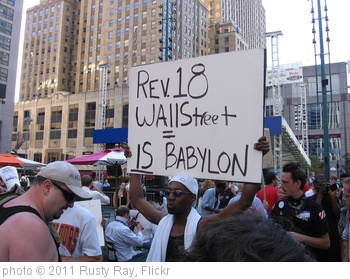
'Occupy Cincinnati' photo (c) 2011, Rusty Ray - license: http://creativecommons.org/licenses/by-nd/2.0/One thing for sure, I find it all too hypocritical that the folks decrying the federal student loan program never actually had to take out student loans themselves to pay for their education. Sorry Mitt Romney, but not all of us have parents rich enough to borrow money from. Sorry, not all of us had parents who earned enough to pay for our education.  Sorry, not all of us got handed great-paying jobs while in college to finance that education. Why is it that the US Congress, which has a median net worth of over $1 million, gets to decide how much my student loan interest rates should be? Especially when the federal government is handing out interest free loans to many of the same banks that crashed our economy. Oh, maybe it’s because banks are getting an $83 billion a year federal subsidy that in turn boosts profits and lines the pockets of investors, which my friend Author Herman most likely benefits from.

Is college expensive? Absolutely. Has the cost of college rise dramatically? You bet. But how is reducing taxpayer funding to higher ed going to help that? How is reducing student loans and Pell grant availability going to bring the costs of college down? The common conservative prescription of eliminating government programs simply pretends problems go away when the program is eliminated.  College is an extremely important part of growing up, and while it may not be essential for all—it is important for many. Whether it be learning new ideas, meeting new people, growing up to become your own person, or meeting that future significant other college is an essential rite of passage in our culture. So to critics like Herman who can do nothing but complain rather than offering decent solutions to make college more affordable, I suggest the old adage, if you don’t have anything good to say, don’t say anything at all.

Wednesday, June 5, 2013

Give more than just money, give a vision!


'Disneyland' photo (c) 2011, Sean MacEntee - license: http://creativecommons.org/licenses/by/2.0/
Have you ever heard story of Walt Disney and the opening of Disneyland?  The story goes that someone lamented that Walt Disney was not alive to see the opening of Disneyland, to which someone else replied, “he did see it, that’s why it’s here.” This story highlights the importance of visioning—being able to see a new way, to imagine things currently not in existence or unattainable.  Vision—and I don’t mean simply 20/20 eyesight—is essential to growing, achieving, and advancing in life. I’m reminded of a Bible verse I heard so often during my time in Bible college.


“Where there is no vision, the people perish” – Proverbs 29:18a KJV

These eight words form just the first half of verse 18 in Proverbs 29, which translated from The Message reads a little clearer. “If people can’t see what God is doing, they stumble all over themselves; But when they attend to what he reveals, they are most blessed.” The verse sits amongst a chapter full of pithy statements and wisdom sayings.  Despite being modernized by Eugene Peterson, the words just seem to have more truth to them when stated in the old King James Version language. “Where there is no vision, the people perish.”

I’m reminded of a Christian film titled The Second Chance, which tells of an inner city church that exists as a mission church of a large, well-to do suburban church.  The story begins at the suburban church on what is “The Second Chance Sunday,” (also the name of the inner city church). The Second Chance pastor is less than thrilled about being there as he doesn’t want to be just brought in for show in order to appease the conscience of the congregation, so they can feel good about where they send their checks off to.  Speaking in front of the church, when he is supposed to be lauding them for their generosity, he rather exhorts that they come down to The Second Chance and support the ministry there.  He proudly proclaims that if they are unwilling to do so they should rather “keep your damn money.”

What the pastor in this movie was getting at is that people don’t just need funds, they need friends. In his book With Justice for All, author John M. Perkins repeatedly asserts that poor people don’t need just the charity of the rich, they need the relationships.  Perkins emphasizes that successful people should go beyond simply writing a check, rather they should take time out of their schedule to mentor an at-risk teen, help a young adult receive job training, or teach a person a valuable business skill. Most importantly of all, Perkins stresses that people need to be shown that a new way is possible; they need to be given a vision.

'Optometry letters from eye chart' photo (c) 2013, Les Black - license: http://creativecommons.org/licenses/by-sa/2.0/
Perkins recounts a time talking to a teenage girl, who was determined to take care of her future children and be a good single mother. Perkins was perplexed that she was content settling for so little, yet then he realized that the teen did not know of another way. She lived in a subsidized apartment building, with rental assistance being structured in a way that discouraged two parent families.   All she saw then was single moms living off subsidies.  She was driven enough to realize she wanted to be the best single mom she could be—but it stopped there. She couldn’t imagine life beyond that apartment building, beyond being a single mom. She needed a new vision.

I’m also reminded of a story I heard on NPR a while back, about a woman who was on disability in a small town in Alabama. The woman suffered from chronic back pain, making any job that required a significant amount of standing simply unbearable.  When the reporter asked this woman what kind of job she would like to have, the woman mentioned a job at the Social Security office.  After some clarification, the reporter realized that the woman did not really want to work for Social Security, rather this was the only job in town she knew of which didn’t require standing. Think about that. She couldn’t imagine a job that would enable her to sit and work—other than this desk job working for the SSA.  She couldn’t see another way.

Charity is easy, clean, and hands off. It enables one to soothe their conscience without ever making a real dent in the problem.  Is charity important? Absolutely, but people need more than just your charity, they need your vision. They need you to come down to the community center and teach them the skills they need to get a better job, they need you to come to their school and help them with their math, they need you to come to where they play and spend time with them, but most importantly they need you to give them a vision for the future. A vision that is different than what they know, a vision that is bigger than what they could previously imagine, a vision, which they can claim for their own and see for themselves. Help them to imagine a new way for themselves.

If you really want to make a difference in someone’s life, don’t just write a check, give of yourself and give them a vision.

Saturday, May 25, 2013

Sometimes, Two Wrongs do Make a Right: Part 2


If you happened to read my previous blog (which I highly recommend!), I proposed that sometimes two wrongs do make a right.  I was writing about the biblical character Tamar, from Genesis in the Hebrew Bible (Old Testament).  She did two things normally considered “wrong” (prostitution and deception) yet was declared righteous afterward. Writing about Tamar, I was reminded of the movie Gangster Squad which I saw last winter.
'No Right Turns' photo (c) 2010, Richard Eriksson - license: http://creativecommons.org/licenses/by/2.0/In the movie, Josh Brolin plays a hard-nosed cop trying to do the right thing in a city owned by a powerful mob boss (Sean Penn).  Brolin’s character is personally selected by the chief of police (a very old looking Nick Nolte) to form a secret unit to wage a guerilla war on the mob, realizing that the mob had bribed judges and killed off witnesses making criminal prosecution basically impossible. The “gangster squad” as they were known, goes on to wreak havoc on the mob by interrupting drug shipments, blowing up buildings, and ruining the mob business all around.  These police officers, normally keepers of the law, operated outside the law, doing things normally considered “illegal” or at least “improper,” in order to defeat the powerful mob. In the end, it was really the only way to defeat the mob, in that the mob controlled the system that was intended to control it.

When I walked out of the movie, I remember thinking that perhaps the Gangster Squad might offer lessons for today.  Now, I must say up front that I do not support the violent methods portrayed in the movie.  I remember the biblical wisdom that “those who live by the sword, die by the sword” (Matthew 26:52) and that violence is not redemptive, but rather in the end only begets more violence.   So with that pre-condition, I would like to propose that perhaps the only way to defeat an unjust system is to operate outside of that system. The Gangster Squad could not operate within the criminal justice system, being that the mob had such an influence over it. In the same way, I am beginning to believe that the unjust systems and structures in this nation and in this world cannot be defeated by working within the system, they must be defeated by working outside the system—perhaps utilizing methods thought of as “illegal” or “improper.”
'Right Turn Only, Use Crosswalk' photo (c) 2008, A Gude - license: http://creativecommons.org/licenses/by-sa/2.0/I am reminded of Martin Luther King, Jr.’s philosophy of non-violent resistance and his insistence that any law which was unfair or unjust toward a certain people group was an “unjust law” and therefore should not be followed.    Let’s remember that slavery was once legal in this country, as was racial segregation, as was discrimination towards people on the basis of religion, gender, and so on. Just because something is the “law” does not make it “right.”   I think even my conservative friends would agree with me that “might does not make right.” Yet that statement alone recognizes that the law is often shaped by the most powerful. It stands to reason then that those in power are going to shape the law in order to most benefit them—as exemplified by what the rich and powerful are continually doing in America.  Therefore, working within a system and framework to defeat the powerful and remove injustice, when that system itself is designed by the powerful to keep the powerful in power, is going to be a losing endeavor every single time.
In America, we are privileged enough to have the capacity to change the law within the confines of the law through democratic elections. Yet those rights are continually being deluded through Super PACs, Corporate money, and voter suppression and disenfranchisement (best evidenced by the voter ID laws).  Still, the possibility remains that the people of this country (after all, this nation is a government of and by the people) could rise up and retake control by limiting the money and influence of Super PACs, limiting corporate campaign contributions, and restoring voting rights. But these three examples I have mentioned are a relatively new phenomenon, happening largely within the last 10 years. It seems to reason that things are only going to get worse, that the rich and powerful are only going to exert more control, continually shaping the system to benefit them and them alone.
So I am left to wonder, what else can be done.  Does America in the 21st century need a great leader like King or Gandhi? Does it need a stronger, more focused and unified movement than “Occupy Wall Street”  was to expose the unjust systems and galvanize Americans to change the system? Or, rather, do we need non-violent “gangster squads” to work outside the system, beyond the context of the “law,” to work instead within the realm of the greater moral law in order to break the unjust, immoral laws that are put into place by the rich and powerful to keep themselves rich and powerful?
Going back to Tamar’s actions then, perhaps in our time as well two “wrongs” can indeed make a right.


***update***

In a previous version of this blog I misspelled "Gandhi" --and perhaps more disturbingly, forgot to mention that the gorgeous Ryan Gosling also co-starred in the movie. My apologies.

Thursday, May 16, 2013

Sometimes, two wrongs do make a right: Reflections on the story of Tamar from Genesis 38:12-26

The story of Tamar shows that the failure of those in the culturally privileged position to recognize the suffering of others does not mean such suffering does not exist. Further, the extreme measures undertaken by Tamar, and the obvious pre-planning done in advance, demonstrates the amount of work that must be done to achieve equality.  The formula is simple, the greater the inequality, the more work that must be done to overcome it. It is then completely unfair of those in the privileged position to criticize those suffering from inequality as not having worked hard enough to overcome such injustice.  Such is what had happened to Tamar. Rather than recognizing the gross injustice done to Tamar by Onan; that he sexually manipulated her, sexually exploited her, essentially sexually assaulted her, Judah essentially assumes she was the problem.  Judah assumes she was the cause of his son’s deaths. He assumes her childlessness was her own fault. Completely oblivious to his own privilege, unable or unwilling to see the great inequality, Judah resorts to taking the easy rode of blaming the one suffering from the gross inequality for not overcoming it.

Interestingly enough, even though Judah recognizes that Tamar was more in the right than himself, he seems content with the situation as is. He still did not choose to do the right thing, Tamar was still a widow denied the right of levirate marriage. Judah acknowledged this unfairness, but made no effort to rectify the situation and gave no indication he ever would do anything for Tamar.  She was dependent on him for justice and he failed her. This demonstrates the problems of a society in which some are dependent on others for justice in society.

'No Right Turns' photo (c) 2010, Richard Eriksson - license: http://creativecommons.org/licenses/by/2.0/In her patriarchal society, Tamar was dependent on Judah for justice.  In society today, many are oppressed and marginalized like Tamar, on the outskirts of society and dependent on those in the culturally superior position for justice.  Only in society today, the justice often takes the shape of charitable giving, in that the poor are often dependent on the charitable whims of givers. Just as Judah came out of the whole event with nothing lost other than hurt feelings, Tamar essentially had to risk her own life to achieve justice.  The societal structure of charitable giving is often the same way. Those in the superior position of charitable giving donate only from their abundance, sacrificing little. They can walk away unscathed, much like Judah, having done little to change the unjust structures that caused the problem in the first place, and like Judah, get some pleasure out of the whole thing thanks to the “warm, fuzzy feelings” of having done “the right thing.

While this text may be useful as an inspirational text for women and others suffering from injustice and oppression, in other ways, it should be an indictment on society then and now.  The Tamar story can easily be interpreted by those in privileged positions as part of the Horatio Alger myth, that despite great injustice and oppression, people can overcome their suffering if they just try hard enough and are creative enough, like Tamar. But Tamar, and others like her, are the exception, not the rule. Rather than reading this story as an inspiration tale, those in privileged positions must rather read this story and others like it as an indictment on their society. Rather than praising Tamar or someone like her for “all they overcame,” those in privileged positions should rather be shaking their head in disbelief at all she had to overcome. Stories such as this should reveal to the privileged the gross inequality that exist in society.

In the end, one must conclude that Tamar, and others like her on the outskirts of society, is indeed righteous.  For the oppressed, this story certainly can be used as an inspirational tale. Tamar used the means available to her to achieve some measure of justice for herself.  Tamar’s story certainly seems to suggest that sometimes to do what is right, cultural “laws” or “norms” must be broken; justice cannot come from within an unjust system. Tamar broke the cultural norms regarding adultery and incestuous relationships to achieve justice. It seems then, in the case of Tamar, that two wrongs do make a right.

Sunday, April 21, 2013

Guns don’t kill people, but video games do??


The logic that comes out of gun rights activists continually puzzles me. After the horrific events at Newtown, NRA president Wayne LaPierre infamously blamed everything except the gun which was used to kill 26 innocent children and teachers.  He blamed violence in video games, violence in the movies, and violence in music. The violence in video games has been particularly targeted as of late by Republicans.  I find this curious, since so many “gun rights” activists say that blaming guns for deaths is the same as blaming a spoon for someone getting fat. Guns don’t cause violence, but a bunch of zeroes and ones programmed to appear on a screen do??

Even more strange is that Republicans have recently taken to accusing liberals of overlooking violence in video games and media.  Conservatives accuse President Obama of giving the video game industry a pass.  Lawmakers are assuming liberals don’t care about the violence portrayed in movies and TV.  What liberals are they actually talking to? This must be more of the bulletproof logic (pardon the pun)that Daily Show correspondent John Oliver noticed recently.  Liberals are almost entirely against violence. Who were the ones protesting the war in Vietnam? Liberals. Who were the ones protesting the war in Iraq? Liberals.

I would self-identify as liberal and I detest violence to the point where I would consider myself a pacifist.  I know lots of liberals who are firmly against violence. I listened to a liberal teen perform slam poetry in which she decried the idea that shooting someone on a screen was somehow “okay,” while pointing out that real-life has no “reset” button.  My first semester in seminary, I took a class on theological issues in films in which the professor mentioned he was unsure about including a couple of movies that had significant violence such as The Passion of the Christ and Unforgiven. My ethics class this semester has an entire section devoted to the problem of violence.  Even today at church in “Sunday School” someone mentioned the problem of violence in entertainment.  So when I hear conservatives and Republicans accusing liberals of not caring about violence in media, I have no idea what they are talking about.

It’s not like all the gang-related shooting in Chicago were from kids playing video games then going out an killing each other.  Poor black kids can’t afford video game systems; its upper middle-class white teens and young adults playing these violent games—aka Republicans.  So, conservative lawmakers need to take a look in the mirror, and at their own voting bloc.

The problem with violence in entertainment isn’t necessarily that kids are going out replicating the violence they see on screen.  The problem is that violence in media desensitizes us the horrors of violence in real life.  When I see bloodied, mutilated bodies on TV, bloodied, mutilated bodies of soldiers and civilians in Iraq and Afghanistan doesn’t hit me as hard.  When I see torture scenes acted out in movies, the horrors of Auschwitz don’t seem so horrible.  Video of men so starved that they were literally skin and bone, of real people being mowed down by the bullets of Germans is less disturbing than that which I can see just by visiting my local Redbox. So yes, violence is a problem in entertainment, but not because it’s supposedly causing kids to go out and kill each other. But if we’re going to accuse video games of causing our violence, why can’t we also blame guns?