Wednesday, June 5, 2013

Give more than just money, give a vision!


'Disneyland' photo (c) 2011, Sean MacEntee - license: http://creativecommons.org/licenses/by/2.0/
Have you ever heard story of Walt Disney and the opening of Disneyland?  The story goes that someone lamented that Walt Disney was not alive to see the opening of Disneyland, to which someone else replied, “he did see it, that’s why it’s here.” This story highlights the importance of visioning—being able to see a new way, to imagine things currently not in existence or unattainable.  Vision—and I don’t mean simply 20/20 eyesight—is essential to growing, achieving, and advancing in life. I’m reminded of a Bible verse I heard so often during my time in Bible college.


“Where there is no vision, the people perish” – Proverbs 29:18a KJV

These eight words form just the first half of verse 18 in Proverbs 29, which translated from The Message reads a little clearer. “If people can’t see what God is doing, they stumble all over themselves; But when they attend to what he reveals, they are most blessed.” The verse sits amongst a chapter full of pithy statements and wisdom sayings.  Despite being modernized by Eugene Peterson, the words just seem to have more truth to them when stated in the old King James Version language. “Where there is no vision, the people perish.”

I’m reminded of a Christian film titled The Second Chance, which tells of an inner city church that exists as a mission church of a large, well-to do suburban church.  The story begins at the suburban church on what is “The Second Chance Sunday,” (also the name of the inner city church). The Second Chance pastor is less than thrilled about being there as he doesn’t want to be just brought in for show in order to appease the conscience of the congregation, so they can feel good about where they send their checks off to.  Speaking in front of the church, when he is supposed to be lauding them for their generosity, he rather exhorts that they come down to The Second Chance and support the ministry there.  He proudly proclaims that if they are unwilling to do so they should rather “keep your damn money.”

What the pastor in this movie was getting at is that people don’t just need funds, they need friends. In his book With Justice for All, author John M. Perkins repeatedly asserts that poor people don’t need just the charity of the rich, they need the relationships.  Perkins emphasizes that successful people should go beyond simply writing a check, rather they should take time out of their schedule to mentor an at-risk teen, help a young adult receive job training, or teach a person a valuable business skill. Most importantly of all, Perkins stresses that people need to be shown that a new way is possible; they need to be given a vision.

'Optometry letters from eye chart' photo (c) 2013, Les Black - license: http://creativecommons.org/licenses/by-sa/2.0/
Perkins recounts a time talking to a teenage girl, who was determined to take care of her future children and be a good single mother. Perkins was perplexed that she was content settling for so little, yet then he realized that the teen did not know of another way. She lived in a subsidized apartment building, with rental assistance being structured in a way that discouraged two parent families.   All she saw then was single moms living off subsidies.  She was driven enough to realize she wanted to be the best single mom she could be—but it stopped there. She couldn’t imagine life beyond that apartment building, beyond being a single mom. She needed a new vision.

I’m also reminded of a story I heard on NPR a while back, about a woman who was on disability in a small town in Alabama. The woman suffered from chronic back pain, making any job that required a significant amount of standing simply unbearable.  When the reporter asked this woman what kind of job she would like to have, the woman mentioned a job at the Social Security office.  After some clarification, the reporter realized that the woman did not really want to work for Social Security, rather this was the only job in town she knew of which didn’t require standing. Think about that. She couldn’t imagine a job that would enable her to sit and work—other than this desk job working for the SSA.  She couldn’t see another way.

Charity is easy, clean, and hands off. It enables one to soothe their conscience without ever making a real dent in the problem.  Is charity important? Absolutely, but people need more than just your charity, they need your vision. They need you to come down to the community center and teach them the skills they need to get a better job, they need you to come to their school and help them with their math, they need you to come to where they play and spend time with them, but most importantly they need you to give them a vision for the future. A vision that is different than what they know, a vision that is bigger than what they could previously imagine, a vision, which they can claim for their own and see for themselves. Help them to imagine a new way for themselves.

If you really want to make a difference in someone’s life, don’t just write a check, give of yourself and give them a vision.

Saturday, May 25, 2013

Sometimes, Two Wrongs do Make a Right: Part 2


If you happened to read my previous blog (which I highly recommend!), I proposed that sometimes two wrongs do make a right.  I was writing about the biblical character Tamar, from Genesis in the Hebrew Bible (Old Testament).  She did two things normally considered “wrong” (prostitution and deception) yet was declared righteous afterward. Writing about Tamar, I was reminded of the movie Gangster Squad which I saw last winter.
'No Right Turns' photo (c) 2010, Richard Eriksson - license: http://creativecommons.org/licenses/by/2.0/In the movie, Josh Brolin plays a hard-nosed cop trying to do the right thing in a city owned by a powerful mob boss (Sean Penn).  Brolin’s character is personally selected by the chief of police (a very old looking Nick Nolte) to form a secret unit to wage a guerilla war on the mob, realizing that the mob had bribed judges and killed off witnesses making criminal prosecution basically impossible. The “gangster squad” as they were known, goes on to wreak havoc on the mob by interrupting drug shipments, blowing up buildings, and ruining the mob business all around.  These police officers, normally keepers of the law, operated outside the law, doing things normally considered “illegal” or at least “improper,” in order to defeat the powerful mob. In the end, it was really the only way to defeat the mob, in that the mob controlled the system that was intended to control it.

When I walked out of the movie, I remember thinking that perhaps the Gangster Squad might offer lessons for today.  Now, I must say up front that I do not support the violent methods portrayed in the movie.  I remember the biblical wisdom that “those who live by the sword, die by the sword” (Matthew 26:52) and that violence is not redemptive, but rather in the end only begets more violence.   So with that pre-condition, I would like to propose that perhaps the only way to defeat an unjust system is to operate outside of that system. The Gangster Squad could not operate within the criminal justice system, being that the mob had such an influence over it. In the same way, I am beginning to believe that the unjust systems and structures in this nation and in this world cannot be defeated by working within the system, they must be defeated by working outside the system—perhaps utilizing methods thought of as “illegal” or “improper.”
'Right Turn Only, Use Crosswalk' photo (c) 2008, A Gude - license: http://creativecommons.org/licenses/by-sa/2.0/I am reminded of Martin Luther King, Jr.’s philosophy of non-violent resistance and his insistence that any law which was unfair or unjust toward a certain people group was an “unjust law” and therefore should not be followed.    Let’s remember that slavery was once legal in this country, as was racial segregation, as was discrimination towards people on the basis of religion, gender, and so on. Just because something is the “law” does not make it “right.”   I think even my conservative friends would agree with me that “might does not make right.” Yet that statement alone recognizes that the law is often shaped by the most powerful. It stands to reason then that those in power are going to shape the law in order to most benefit them—as exemplified by what the rich and powerful are continually doing in America.  Therefore, working within a system and framework to defeat the powerful and remove injustice, when that system itself is designed by the powerful to keep the powerful in power, is going to be a losing endeavor every single time.
In America, we are privileged enough to have the capacity to change the law within the confines of the law through democratic elections. Yet those rights are continually being deluded through Super PACs, Corporate money, and voter suppression and disenfranchisement (best evidenced by the voter ID laws).  Still, the possibility remains that the people of this country (after all, this nation is a government of and by the people) could rise up and retake control by limiting the money and influence of Super PACs, limiting corporate campaign contributions, and restoring voting rights. But these three examples I have mentioned are a relatively new phenomenon, happening largely within the last 10 years. It seems to reason that things are only going to get worse, that the rich and powerful are only going to exert more control, continually shaping the system to benefit them and them alone.
So I am left to wonder, what else can be done.  Does America in the 21st century need a great leader like King or Gandhi? Does it need a stronger, more focused and unified movement than “Occupy Wall Street”  was to expose the unjust systems and galvanize Americans to change the system? Or, rather, do we need non-violent “gangster squads” to work outside the system, beyond the context of the “law,” to work instead within the realm of the greater moral law in order to break the unjust, immoral laws that are put into place by the rich and powerful to keep themselves rich and powerful?
Going back to Tamar’s actions then, perhaps in our time as well two “wrongs” can indeed make a right.


***update***

In a previous version of this blog I misspelled "Gandhi" --and perhaps more disturbingly, forgot to mention that the gorgeous Ryan Gosling also co-starred in the movie. My apologies.

Thursday, May 16, 2013

Sometimes, two wrongs do make a right: Reflections on the story of Tamar from Genesis 38:12-26

The story of Tamar shows that the failure of those in the culturally privileged position to recognize the suffering of others does not mean such suffering does not exist. Further, the extreme measures undertaken by Tamar, and the obvious pre-planning done in advance, demonstrates the amount of work that must be done to achieve equality.  The formula is simple, the greater the inequality, the more work that must be done to overcome it. It is then completely unfair of those in the privileged position to criticize those suffering from inequality as not having worked hard enough to overcome such injustice.  Such is what had happened to Tamar. Rather than recognizing the gross injustice done to Tamar by Onan; that he sexually manipulated her, sexually exploited her, essentially sexually assaulted her, Judah essentially assumes she was the problem.  Judah assumes she was the cause of his son’s deaths. He assumes her childlessness was her own fault. Completely oblivious to his own privilege, unable or unwilling to see the great inequality, Judah resorts to taking the easy rode of blaming the one suffering from the gross inequality for not overcoming it.

Interestingly enough, even though Judah recognizes that Tamar was more in the right than himself, he seems content with the situation as is. He still did not choose to do the right thing, Tamar was still a widow denied the right of levirate marriage. Judah acknowledged this unfairness, but made no effort to rectify the situation and gave no indication he ever would do anything for Tamar.  She was dependent on him for justice and he failed her. This demonstrates the problems of a society in which some are dependent on others for justice in society.

'No Right Turns' photo (c) 2010, Richard Eriksson - license: http://creativecommons.org/licenses/by/2.0/In her patriarchal society, Tamar was dependent on Judah for justice.  In society today, many are oppressed and marginalized like Tamar, on the outskirts of society and dependent on those in the culturally superior position for justice.  Only in society today, the justice often takes the shape of charitable giving, in that the poor are often dependent on the charitable whims of givers. Just as Judah came out of the whole event with nothing lost other than hurt feelings, Tamar essentially had to risk her own life to achieve justice.  The societal structure of charitable giving is often the same way. Those in the superior position of charitable giving donate only from their abundance, sacrificing little. They can walk away unscathed, much like Judah, having done little to change the unjust structures that caused the problem in the first place, and like Judah, get some pleasure out of the whole thing thanks to the “warm, fuzzy feelings” of having done “the right thing.

While this text may be useful as an inspirational text for women and others suffering from injustice and oppression, in other ways, it should be an indictment on society then and now.  The Tamar story can easily be interpreted by those in privileged positions as part of the Horatio Alger myth, that despite great injustice and oppression, people can overcome their suffering if they just try hard enough and are creative enough, like Tamar. But Tamar, and others like her, are the exception, not the rule. Rather than reading this story as an inspiration tale, those in privileged positions must rather read this story and others like it as an indictment on their society. Rather than praising Tamar or someone like her for “all they overcame,” those in privileged positions should rather be shaking their head in disbelief at all she had to overcome. Stories such as this should reveal to the privileged the gross inequality that exist in society.

In the end, one must conclude that Tamar, and others like her on the outskirts of society, is indeed righteous.  For the oppressed, this story certainly can be used as an inspirational tale. Tamar used the means available to her to achieve some measure of justice for herself.  Tamar’s story certainly seems to suggest that sometimes to do what is right, cultural “laws” or “norms” must be broken; justice cannot come from within an unjust system. Tamar broke the cultural norms regarding adultery and incestuous relationships to achieve justice. It seems then, in the case of Tamar, that two wrongs do make a right.

Sunday, April 21, 2013

Guns don’t kill people, but video games do??


The logic that comes out of gun rights activists continually puzzles me. After the horrific events at Newtown, NRA president Wayne LaPierre infamously blamed everything except the gun which was used to kill 26 innocent children and teachers.  He blamed violence in video games, violence in the movies, and violence in music. The violence in video games has been particularly targeted as of late by Republicans.  I find this curious, since so many “gun rights” activists say that blaming guns for deaths is the same as blaming a spoon for someone getting fat. Guns don’t cause violence, but a bunch of zeroes and ones programmed to appear on a screen do??

Even more strange is that Republicans have recently taken to accusing liberals of overlooking violence in video games and media.  Conservatives accuse President Obama of giving the video game industry a pass.  Lawmakers are assuming liberals don’t care about the violence portrayed in movies and TV.  What liberals are they actually talking to? This must be more of the bulletproof logic (pardon the pun)that Daily Show correspondent John Oliver noticed recently.  Liberals are almost entirely against violence. Who were the ones protesting the war in Vietnam? Liberals. Who were the ones protesting the war in Iraq? Liberals.

I would self-identify as liberal and I detest violence to the point where I would consider myself a pacifist.  I know lots of liberals who are firmly against violence. I listened to a liberal teen perform slam poetry in which she decried the idea that shooting someone on a screen was somehow “okay,” while pointing out that real-life has no “reset” button.  My first semester in seminary, I took a class on theological issues in films in which the professor mentioned he was unsure about including a couple of movies that had significant violence such as The Passion of the Christ and Unforgiven. My ethics class this semester has an entire section devoted to the problem of violence.  Even today at church in “Sunday School” someone mentioned the problem of violence in entertainment.  So when I hear conservatives and Republicans accusing liberals of not caring about violence in media, I have no idea what they are talking about.

It’s not like all the gang-related shooting in Chicago were from kids playing video games then going out an killing each other.  Poor black kids can’t afford video game systems; its upper middle-class white teens and young adults playing these violent games—aka Republicans.  So, conservative lawmakers need to take a look in the mirror, and at their own voting bloc.

The problem with violence in entertainment isn’t necessarily that kids are going out replicating the violence they see on screen.  The problem is that violence in media desensitizes us the horrors of violence in real life.  When I see bloodied, mutilated bodies on TV, bloodied, mutilated bodies of soldiers and civilians in Iraq and Afghanistan doesn’t hit me as hard.  When I see torture scenes acted out in movies, the horrors of Auschwitz don’t seem so horrible.  Video of men so starved that they were literally skin and bone, of real people being mowed down by the bullets of Germans is less disturbing than that which I can see just by visiting my local Redbox. So yes, violence is a problem in entertainment, but not because it’s supposedly causing kids to go out and kill each other. But if we’re going to accuse video games of causing our violence, why can’t we also blame guns?

Monday, April 15, 2013

The irony of the tax day Boston tragedy

'' photo (c) 2013, ♫ joyousjoym~ Blessings♥ - license: http://creativecommons.org/licenses/by/2.0/
It’s a tragic irony that the horrible events in Boston took place on April 15, otherwise known as tax day in the United States of America.

It’s ironic because so many Americans spend so much time and energy complaining about paying the taxes that support the police, firefighters, and other first responders who are so important on days like today.  They complain about paying the taxes that pay for federal investigators to track down and prosecute the perpetrators of this horrific event and help prevent others like it.  The taxes that will help the city of Boston rebuild. The taxes that will help support the recovery of the victims.

It’s ironic because once again, our nation will “unify,” saying we all care about one another in the same manner we have after Columbine, 9/11, Virginia Tech, Aurora, and Sandy Hook. Why it takes the death and destruction of innocent lives for the citizens of this nation to truly care for one another is beyond me.

It’s ironic because on a day (tax day) when so many Americans complain about paying taxes which support their fellow Americans, they will turn around and say how much they care for their fellow Americans in light of this tragedy.

It’s ironic because the same people who will tweet out support for their fellow Americans who were victims in Boston, yesterday were sharing status updates accusing recipients of tax-dollar-funded “entitlement” programs like food-stamps, welfare, and other social-welfare programs as “moochers,” “takers,” “lazy,” and worse.

It’s ironic because tax day is perhaps the epitome of Jesus’ words in Matthew 6:21 “where your treasure is, there will your heart be also.” Tax day reveals the truth, that for many people, their treasure—their heart—is concerned only for themselves and their own piles of cash.  Jesus had strong words to say against people who stockpiled their own wealth while ignoring the needs of those around them. He called such people fools and hypocrites, saying such people were not welcome in his heaven.

It’s ironic that people can actually claim to care about their fellow human beings on days like today, and then be so totally careless and callous towards their fellow Americans so many other days of the year.

Thursday, April 11, 2013

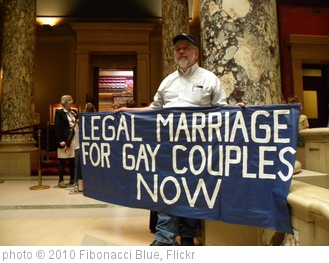
Why my church supports gay marriage...


I'm sharing the following response from my church on this issue of gay marriage:

Recently, a local church made headlines by stating their opposition to gay marriage. The story was front page Easter Sunday in the Boulder Daily Camera. As another Christian community of faith in Lafayette, we at Cairn Christian Church, an Open and Affirming congregation of the Christian Church (Disciples of Christ), formerly First Christian Church of Boulder, openly affirm the right of two people to express their love in marriage, regardless of gender.

We believe this because love was the number one value for Jesus; Love of neighbor, love of self, and love of God.  People who show love are part of the kingdom of God.  If our sexuality, like any other part of our personhood, expresses love and does no harm to another human being, it is far from sinful—it is godly. 
'Gay marriage protester outside the Minnesota Senate chamber' photo (c) 2010, Fibonacci Blue - license: http://creativecommons.org/licenses/by/2.0/

We remember that Jesus treated the marginalized – the diseased, women, children, the poor—with equal dignity and even invited them to eat at his table. He did not treat them as sinners and ask them to change their health status, gender, age or social status in order to be welcomed. His actions were completely against the norms of his day. As followers of Jesus we must then be on the side of the oppressed which are in this instance gays and lesbians seeking equality.

Though we understand the Bible to be a sacred text that has been normative for Christians for hundreds of years, we also understand it is a text written and compiled in a culture far different than our own, thousands of years ago.  We remember that the same Bible that is used to condemn homosexuals also condones child abuse, genocide, slavery, and rape. The Bible prescribes that disobedient children are to be stoned. The Bible thinks touching a woman in public is a sin. The Bible says divorce is a sin. The Bible says disease is a sin. Further, we understand the Bible has been used to justify slavery, misogyny, racism, and more—all within our own country no less.

Trying to define “Biblical marriage” is very slippery. The Hebrew Bible, or Old Testament, allows for multiple wives, allows the man to have a mistress, allows a man to sleep with any other woman without impunity as long as that woman is not herself married. Further, there is no equivalent word in the original language of the Old Testament for marriage.  In New Testament marriage was thought of as unnecessary in expectation of Jesus’ soon return. The Apostle Paul grudgingly conceded marriage but preferred celibacy.  So if we are going to define marriage as “Biblical,” which definition are we going by? Who gets to pick? And why are they right?

'Gay Marriages NYC' photo (c) 2011, Jose Antonio Navas - license: http://creativecommons.org/licenses/by/2.0/
We recognize that the definition of marriage has changed over time.  Marriage once allowed for multiple wives.  Marriage once was a formal financial contract between families and tribes.  Marriage once had little to do with love.    It was once impossible to marry across classes.  Only a few decades ago it was illegal to marry between races.  Our definition of marriage has changed with our changing ethics and our deeper understanding of the human psyche, the human body, and the human community.

Therefore, we of Cairn Christian Church, an Open and Affirming congregation of the Christian Church (Disciples of Christ) affirm the right of two consenting adults to express their love in marriage—no matter their gender.

On behalf of the members of Cairn Christian Church,

Senior Minister Rev. Dr. Charisa Hunter-Crump (BD,MDiv, DMin)
Youth Minister Dustin Adkins (BA, Min)
Seminary Intern Loren Richmond Jr. (BS, MDiv student Phillips Theological Seminary)

(Via: CairnChristianChurch.com/response )